The Story Behind “Abundance”
A Botanical Portrait Rooted in Care, Memory, and Quiet Strength
Abundance
Abundance is one of the first pieces in The Wild Garden, a collection of botanical portraits rooted in memory, place, and meaning. Like each piece in the collection, it began with a person, a feeling, and a flower. As I worked on it, I started to understand that it was holding something much larger than the botanical details themselves.
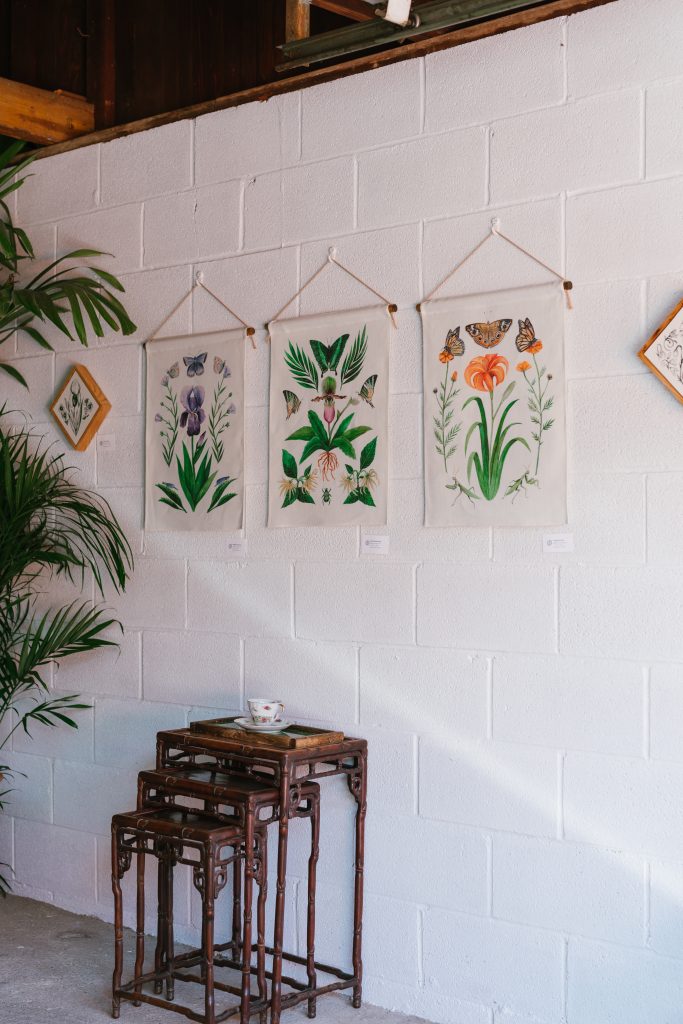
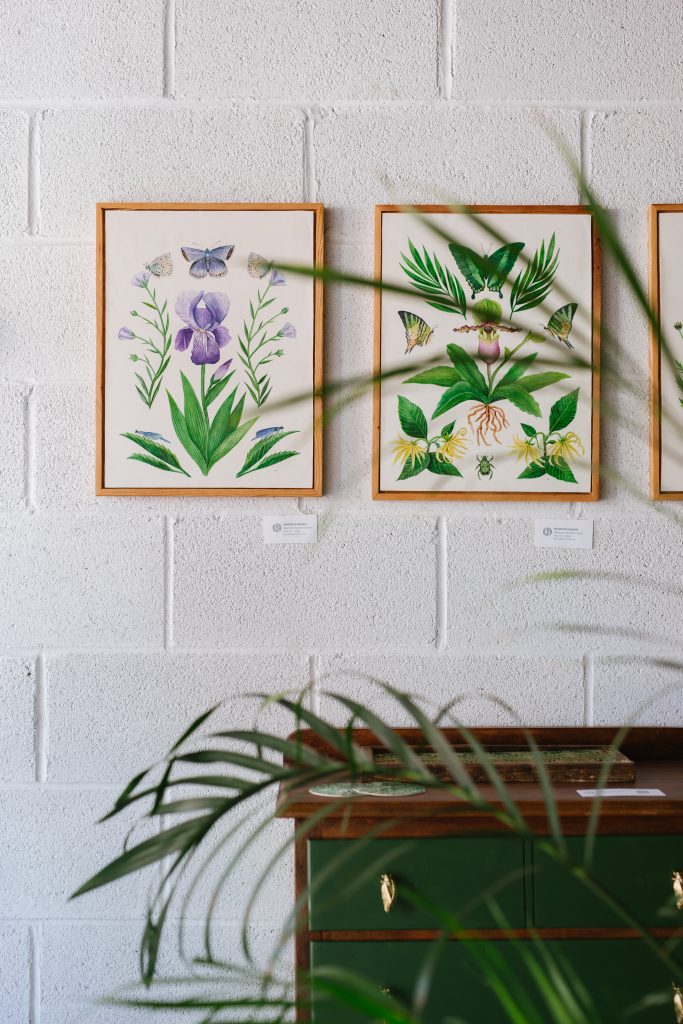
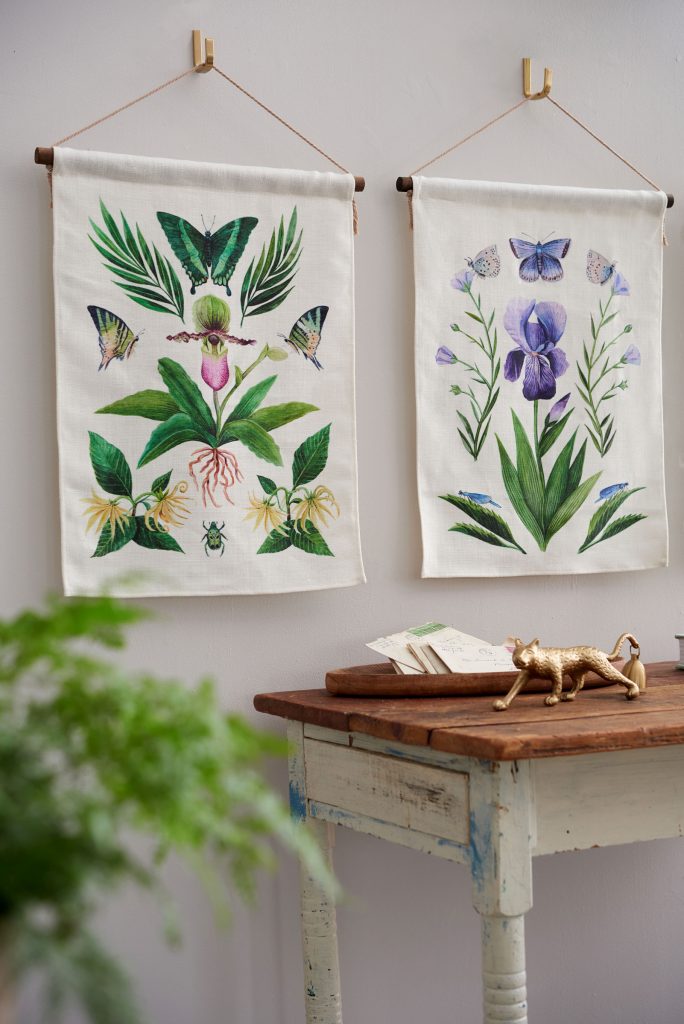
When you first see it, your eye may go to the green orchid at the center, then to the leaves, yellow ylang ylang flowers, butterflies, and small natural details moving around it. There’s a sense of balance, but it isn’t perfectly symmetrical, which is part of what I love about it. It feels full and alive without feeling overly arranged. Like so much of nature, there’s structure there, but there’s also wildness. Everything has its place, but nothing feels too controlled. Abundance isn’t only about the arrangement of flora and fauna.
This piece became the beginning of a larger body of work and helped me discover the art of creating a “botanical portrait.” They aren’t portraits in the traditional sense—there’s no face, no figure, no literal likeness. But they’re still portraits because they hold something of a person through flowers, color, memory, place, and feeling. They invited me to think about portraiture a little differently. Not as an exact image of someone, but as a way of honoring the presence a person carries and the way they make us feel. In the case of Abundance, that person is my mom.

The Person Behind the Piece
When I look at Abundance now, I think it holds the origin of my love of green. That sounds a little funny to say, but here’s what I mean: my mom has the most beautiful green eyes. They’re not a normal green exactly, more of a hazel green that sometimes has blue in it, and I think they may have been my earliest connection to that color. From there, my love of green seems to have flowed outward into plants, water, landscape, and all the greens that show up in nature when something is alive and growing.
That connection makes sense to me because my mom has always loved plants. She’s always had orchids around, and she’s always loved growing them. I remember attending an orchid-growing classes alongside her when I was a young teenager. When I was in college, the first flowers I really painted in watercolor were orchids for a newsletter I put together on the subject. Looking back, I can see how those threads were already there, even before I understood they would become part of this larger body of work. The orchids, the green, the attention to plants, the way certain colors and natural forms can become attached to a person without us realizing it right away.
At the time I began working on Abundance, my mom was going through a health scare, and she was very much on my heart. Naturally, I turned to painting as a way to process my emotions, but I knew I didn’t want to paint her literally. What I wanted to honor was harder to capture directly: the beauty, curiosity, wildness, and abundance that have always felt so much like her.
She’s always been connected to the natural world—she loves plants, animals, flowers, water, open space, and the kind of life that happens when you’re paying attention to what’s growing around you. In fact, she once hid a horse from her mother after high school, using money she had saved to marry my dad, her high school sweetheart. Eventually, the life she built with my dad filled up with horseback rides, puppies, propagating plants, turtles saved from the road, long days at the lake, camping trips, and ponds she still tends. She taught me to notice the natural world, but not by formally teaching me. It’s more in the way she lives. She notices what’s blooming. She cares for what’s growing. She brings plants into the house, spends time outside, and makes the natural world feel like something we’re always in relationship with.
It isn’t only plants. My mom is also a collector, which she gets from her dad. She collects beautiful things, but not just to have them. She collects things that hold memory, things with story, things she knows someone else might love one day. There are five of us siblings, and some of the coolest things we have in our homes come from our mom’s treasure hunts.
That’s the kind of abundance I mean when I think about her. Not excess, and not more for the sake of more. More like an abundance of care, story, beauty, curiosity, and attention. My mom makes the world feel fuller because of what she notices, what she tends, and what she gives.
The Meaning of Abundance
The word Abundance felt right because it holds so much of what my mom represents to me, though not in the most obvious sense. It isn’t about having a lot or filling every empty space. It’s quieter than that. It’s the kind of abundance that gathers slowly over time through care, attention, memory, and the small things someone chooses to notice.
I think plants feel abundant in that same way. They’re prolific, unapologetic, and wild. They don’t ask permission to grow. They reach toward what they need, come back after quiet seasons, and fill a space with life in a way that feels generous and instinctive. Green has always carried that feeling for me. It’s the color of growth and return, but also of life moving quietly beneath the surface. So in this piece, abundance isn’t excess. It’s presence. It’s curiosity. It’s beauty that has been tended over time. It’s the feeling my mom gives me, and the way her love of plants, animals, objects, nature, and story has shaped the way I see the world.
The Anchor Flower
Orchids were already woven into my memories of my mom, they felt like the natural place to begin. I didn’t want just any orchid. I wanted a green one. I wanted the color palette itself to carry something of her, and green felt like the doorway into that memory. The central flower in this piece is a green Paphiopedilum orchid. I was drawn to it first because of the color, but the more I worked with it, the more it seemed to hold the feeling I was trying to express. It had a delicacy to it, but it didn’t feel fragile. It felt alive, structured, organic, and quietly strong. It held something I recognized, even if the connection was more intuitive than literal.
That’s often how these pieces begin. One flower, color, memory, or feeling rises to the surface, and then I follow it. I don’t always know exactly where it will lead, but I know when something feels like the right starting point. The orchid became the anchor for the piece, and once I had that, the rest of the composition began to open up.
The Research Process
After choosing the orchid, I started researching where it was native to. That led me toward Indonesia and the Bali region, and from there I began looking at what else could live within that same ecosystem. I wanted the piece to feel rooted in a real place, not just arranged around a flower because the colors looked pretty together.
That research process is one of my favorite parts of the work because it doesn’t feel cold or academic to me. It feels more like listening. I’m looking for relationships. What grows together? What pollinates what? What colors, shapes, and movement belong to that environment? What small details would make the piece feel like a living world rather than a collection of separate elements? Ylang ylang became part of the composition partly because it belongs to that region and partly because I’ve always loved the essential oil. I associate it with calm, rest, and the way the natural world can give back to us in these quiet, generous ways. That felt connected to the same kind of abundance I was trying to hold in the piece.
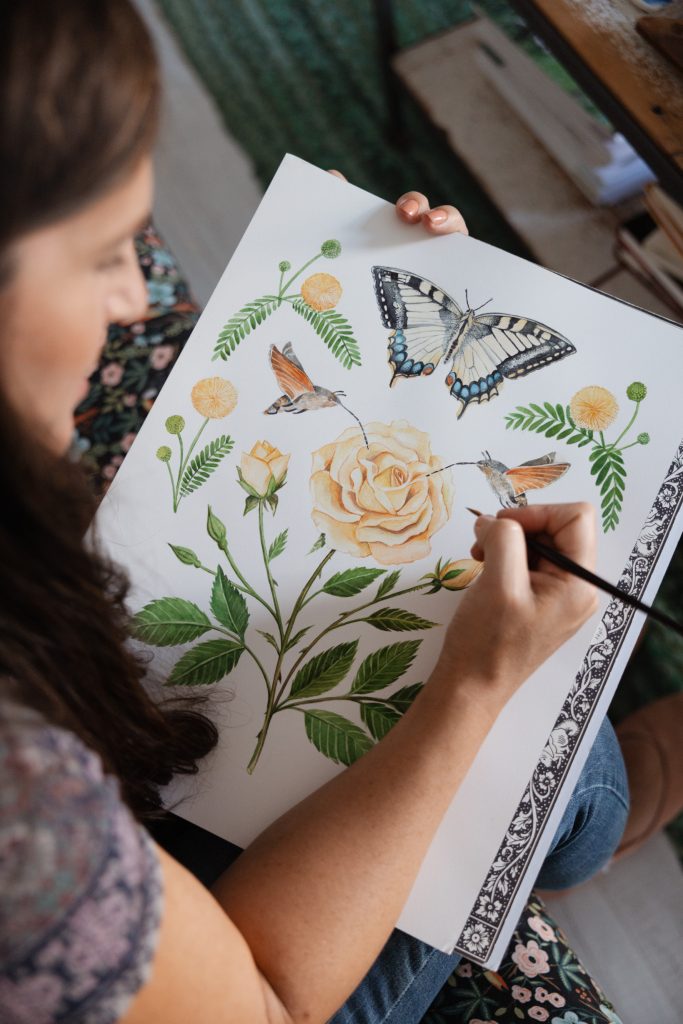
From there, I researched butterflies, beetles, plants, and other natural details that could fit both ecologically and visually. It became a dance between accuracy, symbolism, color, scale, and composition. Everything needed to feel like it belonged in the same ecosystem, but it also had to work as a painting. There’s a lot of thought behind each detail, but I don’t want the piece to feel like a research project when you look at it. I want the research to give the artwork roots, then disappear into the beauty of the piece. I want the details to feel so naturally connected that the little world in the artwork could almost exist on its own.
The Visual Composition
Once I had the orchid and the supporting elements, the composition became about finding the right balance between fullness and restraint. I wanted Abundance to feel generous and alive, but not crowded. The orchid gives the piece its center, while the surrounding plants, butterflies, and smaller details create movement around it.
There’s a lot of symmetry in the piece, but it’s not perfectly symmetrical. It looks balanced at first glance, but it’s actually more asymmetrical than it may seem. I like that tension because it feels true to nature. A garden can hold both order and wildness. It can be layered and growing in many directions, but still feel like everything belongs.
I usually begin with research and a sketch, but these pieces always evolve as I work on them. There’s a point where the planning gives way to listening, and I have to pay attention to what the piece is asking for. Something may need more movement, more balance, more quiet, or more grounding. That part of the process is harder to explain, but it’s where the artwork starts to feel alive.
What the Piece Holds
What I love about Abundance is that it doesn’t try to explain my mom. It holds a feeling of her. To me, it holds the way she has shaped how I see plants, color, beauty, and the natural world. It holds the green of her eyes, the orchids she grows, the objects she saves, the stories she carries, and the way she makes ordinary things feel alive with meaning. It holds the feeling she gives me: curiosity, beauty, wildness, generosity, and a deep connection to the earth. Using flowers was my way of translating that. This is why the idea of a botanical portrait feels so meaningful to me—it can carry someone’s presence without needing to show their face.
Custom Botanical Portraits
I think that’s what I love most about this way of working. It leaves room for the parts of a person that aren’t always easy to describe. Sometimes it’s a flower they loved, or a color that always makes you think of them. Sometimes it’s a place, a scent, a season, or some small detail that would seem ordinary to someone else but holds a whole world for you. Those are the details that stay with us. The ones that bring someone back for a moment, not because they explain everything, but because they hold something true. I love the idea of artwork that can carry that kind of meaning quietly.
If you’re interested in creating a custom botanical portrait, click below to reach out. I’d love to connect and learn more about the person you want to honor.

A Meaningful Story, Painted for You
Perhaps there is a plant that reminds you of someone, a garden that feels like home or a landscape you would like to hold onto. I create original botanical and landscape commissions shaped around the places, memories and details that matter to you. Learn more about the available formats, investment and what it is like to commission a piece.